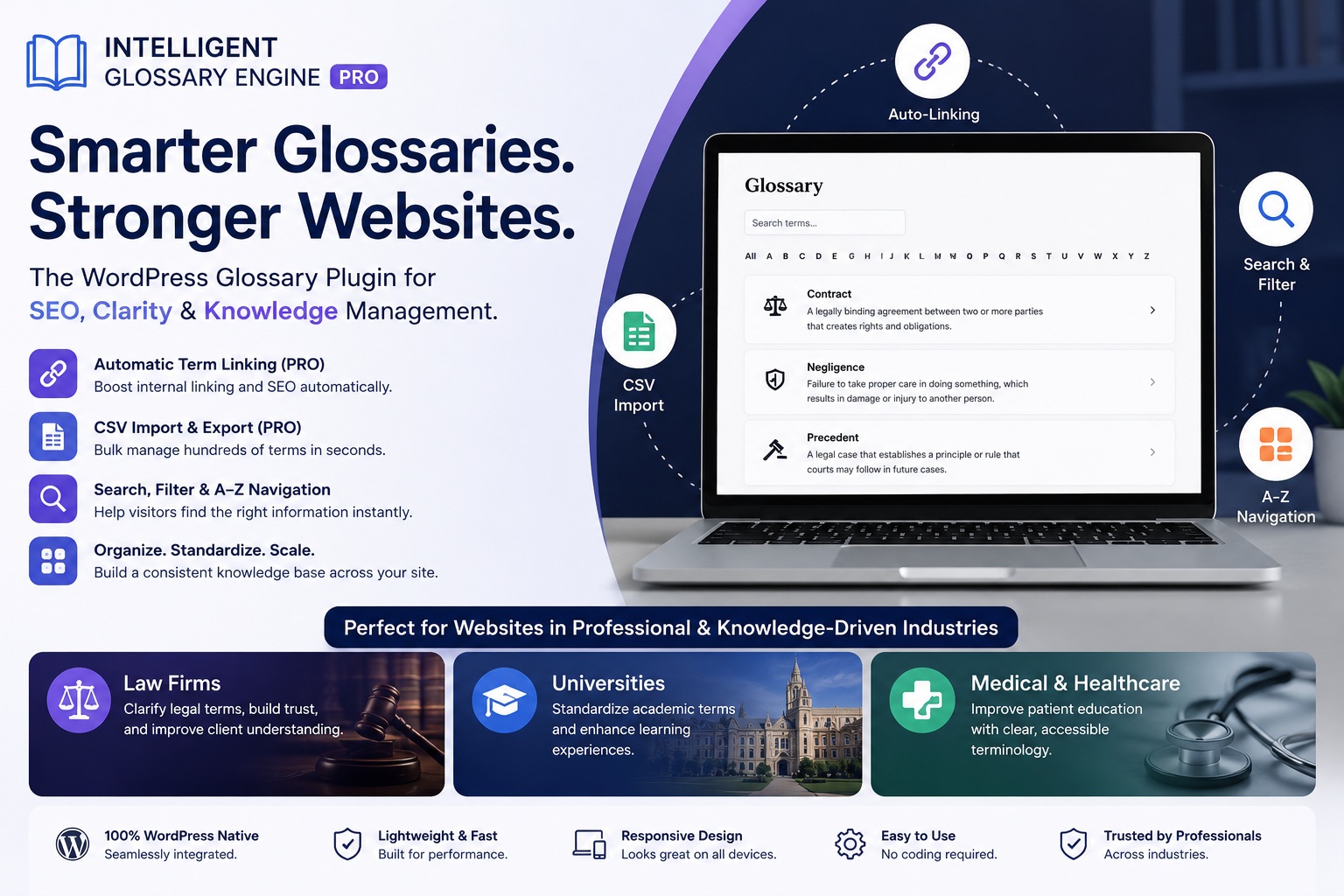
If your website contains technical terms, industry jargon, abbreviations, or recurring keywords, manually creating glossary…
Why UTF-8 Compatibility & Diacritic Indexing Matter in Scholarly Glossaries
When building a glossary for academic, religious, legal, or multilingual content, handling language correctly is not just a visual detail, it directly affects usability, searchability, and long-term data integrity.
One of the key improvements recently implemented in the glossary system is enhanced UTF-8 compatibility alongside diacritic indexing normalization. While these may sound highly technical on the surface, they solve several important real-world problems for both administrators and end users.
Supporting Scholarly Romanized Terminology
Many scholarly and transliterated terms use diacritics to preserve pronunciation accuracy and linguistic precision.
Examples include:
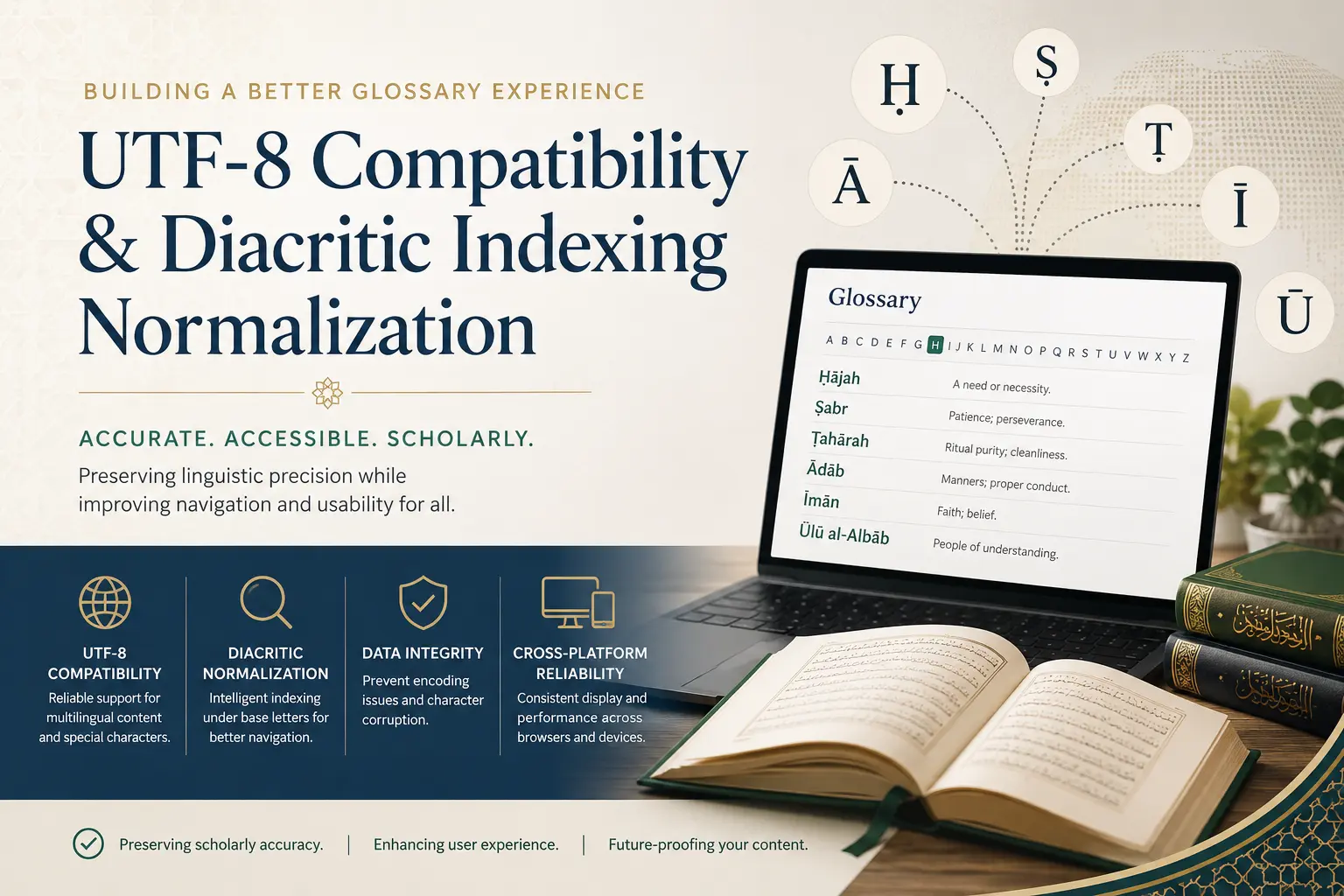
- Ḥājah
- Ṣabr
- Ṭahārah
- Ādāb
- Īmān
- Ūlū al-Albāb
These are not ordinary English spellings. They are academically transliterated Arabic terms written using the Latin alphabet with additional diacritical marks.
Without proper handling, glossary systems often:
- fail to index these terms correctly
- break search functionality
- display corrupted characters
- create inconsistent alphabetical navigation
For example, a term such as “Ḥājah” may not appear under the letter “H” at all if the system only recognizes standard ASCII characters.
Improved A–Z Navigation Experience
With diacritic indexing normalization, transliterated terms are intelligently grouped under their equivalent base letters while preserving their correct scholarly spelling.
Examples:
- Ḥājah → indexed under H
- Ṣabr → indexed under S
- Ṭahārah → indexed under T
- Ādāb → indexed under A
This creates a much more intuitive experience for users browsing the glossary, especially readers unfamiliar with specialized transliteration systems.
The result is a glossary that remains:
- academically accurate
- easier to navigate
- more accessible to general audiences
Why UTF-8 Support Is Critical
UTF-8 is the international encoding standard that allows systems to correctly store and display multilingual characters and special symbols.
Proper UTF-8 support ensures:
- correct rendering of diacritics
- reliable search functionality
- accurate CSV import/export behavior
- stable auto-linking
- compatibility across browsers and devices
- prevention of character corruption over time
Without proper UTF-8 handling, terms can become corrupted into unreadable characters such as:
ḤÄjah
’This is a common issue in systems that are not properly configured for multilingual content.
Long-Term Benefits
These improvements are especially important for:
- Islamic studies platforms
- academic institutions
- multilingual websites
- research archives
- legal and medical terminology systems
As glossaries grow larger and more sophisticated, proper character normalization and encoding support become foundational requirements rather than optional enhancements.
By implementing UTF-8 compatibility and diacritic normalization correctly, the glossary system becomes significantly more scalable, reliable, and future-proof for scholarly content ecosystems.

Related Posts